Showing posts with label Religion. Show all posts

Sunday, June 12, 2016

Sexism Rooted in Religion and in Society Today


It may be true that society has changed so much over the years and have benefitted everyone. But has it really? People have gotten discriminated against harshly in the past. Most of them women. This may be because of the gender norms and religion beliefs from the past that have over time, modified the way we see different genders. It has affected how different occupations treat women in economic and social ways, and how the media portrays women in society. Religion and gender stereotypes of the past have negatively influenced the sexist behavior (gender inequity) in society today.

Religion may be one of the root causes to gender stereotypes and profiling. In many religions, women have less of a job and men are more powerful. “The religions themselves practice overt discrimination against women within their own institutions. They are run by men for men.” (The roots of sexism in religion) For example, in Christianity, many leadership roles such as the pope, bishops, priests etc are only allowed to be run by men. This shows that already in the past, there weren’t that many women figures. In some other religions, women were just seen as objects that were used for sex or chores. Another example, in the Islamic religion, women are meant to be feminine figures and men masculine. Although this may be sometimes true in the physical sense, that doesn’t mean that all women should be seen in this way. Not everyone has the same idea on how women should be perceived. This is one of the reasons why there are stereotypes that follow this belief.

Stereotypes rooted from religious and social norms of the past have made it harder for men and women to be equal in economic and social terms today. Women have been idealised to do jobs with ‘less brain power’ and more caring, ‘easy’ jobs. Who’s to say that men can’t do them either? Even when men and women have the same job, they still get treated unfairly. “The median earnings of men with full-time, year-round jobs were $50,033 last year, [2013] compared to $39,157 for comparable women.” (The Wall Street Journal, 2013) That’s about a $10,000 difference. Referring back to the earlier point, this may be because men were/are viewed as more powerful therefore sometimes getting paid better.

Sexism has been going on for as long as we can remember. Another example of a time where sexism was a common occurrence was in Salem, Massachusetts in the early 1690s. This was the time of the Salem Witch Trials. Many young women were being accused of harnessing witchcraft and many of them were hanged, even if they were innocent. “ If well-respected men observed the young accusers and reported that their fits were real, then the court would be heeding not just a girl, but an established man.” (Witch-Hunt: Mysteries of the Salem Witch Trials, Marc Aronson) Society chooses to see the good and bad in people. Sometimes they choose to see the good or bad in certain people. Back then, they chose to see the greatness in men and women were just in the shadows. In the quote above, it says

Men and women are being portrayed differently in the media giving society false ideas. The media’s job is to manipulate people’s brains into thinking that they want or need something. For a long time, they have been using people to sell their product or services but in different ways. “I guess the sexism kind of morphed, it didn’t go away or necessarily get better.” (Buzzfeedyellow, 2015) Women usually get exploited to get men’s attention. You may be familiar with the saying “sex sells”. The media certainly believe so and so must the viewers because now there is more of a demand for ads of this genre because companies keep producing them.
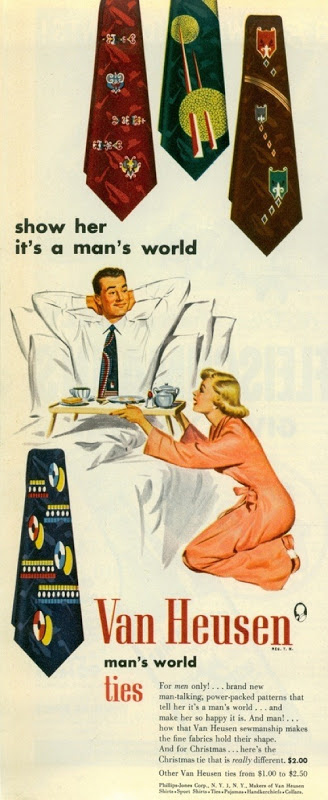


The ad to the left is from the 1950s and shows a woman serving a man. The caption reads “Show her it’s a man’s world” This is saying that men are dominating in the world and women are just servants to the men. The ad on the right shows a male and a female advertising the same shirt. The man is casually wearing the shirt but the woman is sexualising it. The object of the ad was to show that the shirt can be worn by men and women but it looks as though both ads are directed to get men’s attention. The media is using people to meet the sexual craving to sell their products and women don't deserve to be treated as an object.

People who practice religion may believe that stereotypes have many other possible roots and that there is nothing to be done about it. It’s understood that people have different opinions on the subject but because of the beliefs of religion and the stereotypes that have formed because of it, sexism is still a problem in society today. Women (and sometimes men as well) are being taken advantage of in media, in economic terms and just in general and it needs to be stopped.

RELIGION VS SCIENCE, WHAT'S THE TRUTH?


Ever since science and religion started drifting away, both have been trying to subsume each other. Many people believe in either religion or science, and firmly. Between these two extremes there are still a few who are both scientific and religious, but don’t know whether a bridge can ever cross the divide. Most theists use God as an idol for them, a divine being who knows the answers to everything and can solve all the world's problems, or maybe even create some. But does God really know everything? Can He solve all our problems? Maybe he can, but in this moment of time we have no idea where God is, where he resides or even his physical features. Although there are various holy scriptures describing him in much detail, we can’t merely trust them and they may just be some man made nonsense. In theory we have almost none to no factual evidence about this deity. What if God is just another Santa Claus? But we have something known as science which bases all conclusions with evidence and factual proof for any of it’s conjectures. Through science we have also come to prove many religious beliefs wrong and along with that include facts to explain why so. Although it's not wrong to believe in a religion, no one really knows the whereabouts of religion and even if God is real, religion has shown to cause many conflicts and science provides more factual evidence than religion.

The start of the universe, a time when all organisms started their journey of evolution has been debated heavily amongst religion and science. This dispute is more intriguing because even science can almost never know how the universe was created and can just go as far as to find various compelling pieces of evidence. A few religions, such as christianity and islam, believe that “the heavens and earth were joined together as one unit. God created the world in six days,” but an important aspect is that a “day” in Islam can be denoted as any amount of time, this is also known as a “yawm.” Science has different thoughts on how the universe came into existence. This theory is known as the big bang and includes three very convincing pieces of evidence. The big bang reveals that “the Universe is expanding (and cooling) now, meaning that all the matter in it was closer together — and the radiation in it was hotter — in the past.” The first piece of evidence is known as red-shift. Red shift indicates long wavelengths, therefore representing something moving farther and farther away. Now, scientists have been calculating the rate at which the universe is expanding, it is going at a steady rate and seems to be following hubble's law. Hubble’s law states that tomorrow galaxies will be farther away from us, yesterday they were closer to us and at some point all the galaxies were on top of us. Hubble’s measurements all seemed to imply that the universe began small, in a condensed state and then expanded outwards therefore helping to solidify that the big bang could be valid. The second piece of evidence is known as cosmic microwave background radiation, and can also be called the CMB. The CMB is a radiation scientists discovered and can be classified as the earliest form of radiation that can be detected. The CMB also helps display that the early universe was a very hot place and as it expands, the gas within it cools down too, this perfectly describes the conditions during the big bang. The third piece of evidence is called the abundance of hydrogen and helium. It is believed that after the first hundred seconds of the big bang hydrogen and helium were made with a chemical reaction known as nucleosynthesis because they were the least dense and required the least amount of energy. This is crucial as it helps us prove the big bang right since nucleosynthesis’ formula describes a hot and dense environment then producing lighter elements to help balance everything out. This formula also helps mimic the environment it would’ve been during the big bang. All in all most would probably say that the science had more trustworthy and backed up evidence than the religions. These pieces of evidence also finally helped make a theory somewhat correct and may be truth for how the universe started. Islam was slightly correct as it stated that “God created the world in six days,” and essentially in Islam a day can be any period of time, and the amount of time taken for the big bang is unknown, so theoretically Islam could be right to some extent. Although that is the case, the literal meaning of the religious theory is that God joined the heaven and earth into one unit. But who even is God and can he really be trusted?

“Matthew 7:7, Ask, and it will be given to you.” God claims that whatever prayer you say to Him will come true that’s also the main reason why people pray. To put this in context say you have a test coming up and you’re stressed out, many would take God’s name so that he will make all your wishes come true and help you do well on this test. But is that always the case? The answer is no. If something does go well after reciting any sort of prayer it could merely be a coincidence or just an incident of good luck. It could be reasonably contended that God only listens and answers prayers that are of good intention and that will help for the better, but then why would God claim to answer every prayer. Many scientists and historians have also found that various holy scriptures may just be man made books that ordinary people have created, and definitely not a divine being. According to The Daily Squib, religious texts are just “man-made nonsense.” Their findings lead to the conclusion that it is odd that almost all religions created their writings in a very limited period of human history. Moreover writing on a medium such as paper “is not the word of God” and if they were actually written by an entity they should encompass all universality. There is no factual or rational evidence that shows that religions have any actuality because they are entombed in such a limiting and brief period in history which and the only piece of evidence we have from this time are various holy scriptures and religious texts. These books should be perceived as historical fiction as they just show us the faithful virtues and findings of the people living in that specific era. In science everything is explicitly sourced. You can instantly find out who created a theory why it's valid and so on. Science conjointly is not confined to a time period, we are constantly finding and learning, it never stops. We can also use science to figure out credible discoveries - none of them are just based on luck and definitely aren’t a coincidence.

Religion is also seen to be the main cause for war and conflicts. According to Louise Ridley, writer for The Huffington Post, believes that “religion is the main cause of wars. Without faith, many say, there would have been no 9/11 attacks, no Israeli-Palestinian conflict, no Troubles in Northern Ireland, no violent disputes over words in holy texts - even no Islamic State,” this point is very valid as many of the conflicts we have witnessed are based on a person's religious beliefs. To give an illustration, the Islamic State in Iraq and Syria, believe in assassinating people because they say “that’s what the Koran taught us.” Well, yes it did, if you take it literally. The Koran believes in implementing methods of slavery and crucifixion if someone has done wrong, and only if someone has done wrong. But the ISIS group have now started implementing this methods on everyone, in the name of religion. Many attacks have been carried out by religious groups or extremists in hopes of satisfying “God.” If religion is the reason why millions, or even billions of people’s lives are in danger, that shouldn’t be a reason why people have faith in it. Religion should be a factor in life which helps bring peace and embrace spirituality, not be the cause of people’s deaths.

But religion can be beneficial for us too. Prayer is seen to be healing to the soul and even cure illness’. A study was conducted by a team from the Indiana University who believes there is more to this. They found a case regarding an elderly woman, “who could not see a person's hand when they held two fingers up in front of her face from a foot away.” She was cured after a well wisher placed their hands on her forehead and recited some prayers. In less than a minute “she was able to count [the fingers] and even read the 20/125 line on a vision chart.” The reason the strength of prayer being a remedy is still unknown but we could come to the conclusion that there is a divine power who watches over and protects those who have faith. Additionally religion helps embrace spirituality, it’s a simple way to help satisfy many basic needs such as order, curiosity, idealism, along with others. According to Professor Steven Reiss, a psychologist at Ohio State University, concludes that “religion is simply an attempt to satisfy 16 basic human desires that afflict all human beings.” While people may believe that God has a strong power, those who aren’t as strong of believers can find the idea of God being an image which is created to be appealing for humans isn’t too far fetched. Additionally, Jeffrey Dorfman, writer for Forbes magazine, states that “studies have shown that religious attendance once or more per week leads to an extra seven years of life expectancy.” Just engaging in religious activities more than once a week can help you increase your lifespan. This could mean that since religion helps satisfy sixteen basic human needs, this helps in the long run, by making you and your immune system much stronger. All this evidence helps prove that religion is not wrong to have faith in, it does help your overall well-being in multiple ways. But, it is important to understand we have no idea as to where and who is the controlling power over religions, so science does seem to be much more valuable in that sense.

As a species who are complex, we must take into consideration the consequences that may be if we don’t understand both sides of the situation, science and religion. Even though it isn’t wrong to think religion may have some truth to it, we must take into account that science has more substantial practical application. Science has also proved religion to be inaccurate in quite a few circumstances.


**I'm not completely finished

Sunday, March 20, 2016

Personal Appearance And Personal Identity


Adolescence is a time at which people from all places and cultures struggle to form their own identity. No longer children, but not yet adults, they must forge their sense of self and come to terms with the image they project to others. For young girls in particular, self identity and image is often closely associated with physical appearance. “Blue Gold” and “ Does My Head Look Big In This?” are both coming of age stories in which young girls from different places and cultures struggle to form their own identities, and in each of the stories physical appearance and clothing play an important part in the girls’ journeys towards self affirmation.

“Blue Gold” is a three part story which confronts the issues surrounding the technology industry through the stories of three girls from very different cultures in living in very different circumstances in different places around the world. Each girl must try to find her sense of self and make a place for herself in society. “Does My Head Look Big In This?” is the story of an Australian-Palestinian-Muslim girl and her journey towards self discovery. She must reconcile her Palestinian Muslim heritage within her place in secular Australian culture. A shared theme between these two books is that physical appearance and dress are central to self identity and image.

In “Blue Gold” Elizabeth Stewart uses Laiping’s uniform to show her loss of self identity and freedom. Laiping is a Chinese factory worker, the factory uniform, identical to thousands of others, demonstrates Laiping’s insignificance in the eyes of the company that controls her. Her uniform strips her of her personal identity and transforms her into “just a factory girl, like a hundred thousand others.” Laiping loses all sense of self and self empowerment. The idea, of clothing having the power to take away identity as well as display it, is also prevalent in ‘Does My Head Look Big In This?’ Once Amal starts to wear the hijab, people perceive her differently; “Too many people look at it as though it (the hijab) has bizarre powers sewn into its microfibers. Powers that transform Muslim girls into UCOs (Unidentified Covered Objects), which turn Muslim girls from an 'us' to a 'them.” When Amal dons the hijab people view her not as herself but as a Muslim, they ignore her character and focus her religion alone. To Amal this is not the way the hijab should be viewed. To her it is a symbol of her religion of which she is justly proud, it is not meant to strip her of identity but help project it. Throughout the story, Amal meets many people who are weary of Islam and who see the hijab as the single most important thing about her. However fortunately Amal also meets people who understand that the hijab is simply a symbol of her religion, an important part of her identity but not her sole defining characteristic.

In “Blue Gold” the story of Sylvie, a Congolese girl who is trapped in a refugee camp in Tanzania, is closely linked to her personal appearance and dress.The main focus of her story is her impending forced marriage to a ruthless warlord named Kayembe. Kayembe wants to marry her because she is pretty, he has no interest in her character or values. He views her as an attractive chatel. On the day of her wedding she is forced to wear a dress chosen by Kayembe.The dress is described as being too long and having “wires in it to shape a woman’s bosom.” Clearly Sylvie is being forced into womanhood too early, she is entirely under Kayembe’s control, her identity and self empowerment are being stripped away and the wedding dress is a powerful symbol of this . Conversely while many people in Amal’s story assume that the hijab is a symbol of oppression and that she was forced into wearing it, when this is definitely not the case. The hijab is an integral part of Amal’s self identity and image. Amal chooses to wear the hijab without any pressure from her parents. She does so because she is proud to be a muslim woman, to her the hijab demonstrates her identity and self empowerment.

In “ Blue Gold” Fiona’s story is one which concerns body image as part of a young girl’s self perception and identity, which can be connected to one of Amal’s friends, Simone. Fiona’s world comes crashing down around her as a topless photo that she foolishly sent to her boyfriend is released onto the internet. She is bombarded by unwanted comments from her peers, as well as people she has never met. She loses confidence in herself and her body. The lack of clothing in the photo is not only a plot point, it is a symbol for her vulnerability. In “Does My Head Look Big In This?”, Amal’s best friend Simone also struggles with body image. Poisonous barbs from her mother and judgmental comments directed at her by other students lead Simone to loathe her own body. She tries desperately to lose weight and to achieve a perfect and unattainable figure. It takes the kindness and love of her friends to convince Simone that she is beautiful no matter what she weighs, just as it takes the love and understanding of her mother, teachers and friends to help Fiona regain her confidence and self identity.

Physical appearance and dress contribute to the way we see ourselves and others. The authors of both books understand this and harness the concept in the development of their characters and storylines.“Does My Head Look Big In This?” takes a very overt position with the clothing being a central theme of the book whilst “Blue Gold” weaves the symbolism of clothing (and even the absence of clothing) into the underlying stories.”Does My Head Look Big In This?” forces the reader to confront the issue of clothing and question whether clothes make a person or whether they are merely another layer of the character's identity. In Blue Gold, however, the theme of physical appearance and dress was largely understated however when focussed upon was both powerful, intended and well considered.

Sunday, December 6, 2015

Don't Listen to the Stereo

From a young age, we are introduced to a world full of stereotypes. Specifically, gender. The media, our parents, our religion and our society are just some of the aspects that influence our beliefs and in a way, have overtime created gender stereotypes. They can sometimes teach us unideal ways of living. Stereotypes categorise humans into groups that tell us what we are meant act or be like, which in result can make many feel untrue to themselves or like outcasts.

Her life has been set out for her. Finish school, get married, have kids and support the breadwinner of the family.

Noshin is terrified as she overhears her mother on the phone with her grandmother, sobbing one night, saying that her life has been ruined by the men in their family. Her grandmother’s whole life consisted of assisting men and she could hardly be her own person. She didn’t want to live like that anymore. Noshin cries to herself thinking about how unfair her grandmothers life was. “In my country, Bangladesh, women are treated more as maids” said Noshin Saiyaara, 14. “The life of a girl; clean the house, cook and take care of the kids.” This makes it clear that to this day, there are still unequal and stereotypical behaviour in society. This could be because of her religion and that they believe it's right. But is it? Should this be socially acceptable in a society where more and more cultures have grown to be more open about the decisions that women make to become more of equals and not maids?

Noshin told our journalist that she wants change. Her siblings and herself are determined to change the traditions of her family to benefit their lives for the better. “I want to change the routines of my family. I’m not going to sit around and do nothing, I want to work and contribute to my family.” Her experience has empowered her to change their ways, to be who she aspires to be in the future.

From a variety of people that took part in a survey on their thoughts about where stereotypes originated, the most commonly agreed opinion, with more than 50% of the surveyed people, is that stereotypes have been an ongoing tradition for a very long time. For instance, during medieval times there were little to no women as knights and it was the men's job to be chivalrous towards the women. Women were thought to be more delicate so their jobs were often to do housework and cook and maintain the family.

In modern day, we have come to a point where stereotypes have been advertised so much, that they have started to infect more and more of the human species into thinking that they might be true. Isabella Duncan, a student from an 8th grade english class thinks that “Overtime, stereotypes have been reinforced by people with fixed mindsets.” In many ways this is true. Through the people in the media and our society, the message that women and men are different and not equals is very clear statement. You may not realise it, but everyday the commercials you see can have traces of gender stereotypically and it’s hard to realise it because they’re just so common.

Many ideas are reinforced through television to a specific audience. To do this, commercials have to make it relatable to the audience hence, showing things a girl and/or boy would do. In the case study “GENDER STEREOTYPES IN MASS MEDIA” by Malgorzata Wolska, she states “More and more commercials are directed to children. They indicate ‘the proper place’ in the society for girls and boys. Girls are shown as babysitters nursing dolls or cleaning house with a pink cleaning kit, whereas boys do sports or play computer games.” It mentions that most commercials main target audience is children, so the concept of gender stereotypically is already being engraved into their heads. In the future, when they understand how it impacts their identity, they will have a ‘template’ to follow.

Everyone can be affected because of gender stereotypes in many ways. Having to be a certain way and being surrounded by people who support gender stereotypes, can sometimes result in peer pressure and bullying. Life as a middle schooler can be hard, considering that there are lots of pressures with fitting in with others. A middle school student who wished to remain anonymous, tells their story “I am a dancer and a singer and that's what I want to do when I'm older. Ever since I was young, I've been bullied for doing what I like to do. I started hanging out with girls because some of them had the same interests in dance as me or they just understood. I think boys are more disturbed with the stereotype issue and they find it harder to welcome misfits, than girls do.” What is revealed here is that sometimes, people can get peer pressured if they don’t follow a stereotype because it's unfamiliar to others, so the action and person is slightly alienated.

What's strange, is that it's harder for a boy to enjoy something that usually a girl would like, than the other way around, because they usually get picked on by other boys who are more manly. Rhea Goyal’s theory for this is that “In the past, boys have generally been viewed as stronger, smarter etc. while girls were viewed as inferior to boys, so now society says it’s okay for a girl to move up to a boy’s standard, but not okay for boys to move down to a girl’s standard.” It suggests that by being a boy and doing things a girl would do, it would make you less of a man, and that you are admitting to being weak.

Lately there has been less discrimination towards people that happen to go against the grain of a stereotype, but it still happens. If you are someone that is in this situation, know that you are not alone and that there are always going to be people to help and are going through something similar. Its great to be yourself, to be unique. Don’t let stereotypes and hateful comments from others hold back what you desire to be or do. “There shouldn't be any barriers or force, because people's choices are their own,” said Noshin Saiyaara.

Let's imagine that all these concepts have been compiled and put into a stereo. Some of the music could be great, and you like to listen to it, but sometimes there is going to be bad music. People might have different tastes to you, but you don’t need to change your taste to please others.

The Impacts of Stereotypes on Children and Society


A girl walks down the hallway with a basketball under her arm and a smile on her face. Suddenly, a group of boys run past knocking the ball away. “Girls can’t play sports.” They laugh as the ball bounces down the hall and the happiness drains out of her. She, along with many others is a victim of stereotypes. Stereotypes are everywhere, and affect the way people view the world around them. From a young age it is imprinted on children that because you are one way, you must do a certain thing or because you believe something, you are the same as everyone else who believes something similar. The people most often caught in the crosshairs of stereotypes, are children. Stereotypes form the way children think about themselves; being so young they are are very impressionable, so if someone tells them something, it sticks.

One parent of a child at UWCSEA East has had an experience with one of the many common stereotypes. “I wanted to buy a construction house building kit for my daughter, but they only ones I could find were in the boys section and I worried that I was buying something not appropriate for girls.” She says. This illustrates a common misconception. In every store most baby clothes are coloured in the way associated with that specific gender. There are stereotypical toys for each gender as well. In the “girls toys section” there are dolls, cooking sets and beauty kits as if preparing them for a life staying home, cooking and taking care of children. In the “boys toys section” there are soldiers, cars and fake guns as if telling them to be violent is the only way to be “manly”. These stereotypes affect children from a very young age and influence gender roles later in life. The children can think it isn’t right to like something from the other gender, and if they do like it then they can feel out of place amongst their friends. This may force them to create a version of themselves that isn’t true to who they actually are.

Noshin Saiyaara is a grade 8 student at UWCSEA East whose life is full of stereotypes. “Most of the stereotypes I face are from my own family, saying that because I am a girl, my life should basically be about school, marriage and becoming a housewife.” She says. This reveals that gender roles are also deeply buried in society’s views. Children can even experience them from their own family. In traditional families it is believed that the role of a woman is to take care of her husband and children, while the man goes out and earns money for the family. In some families this model may work, however girls are capable more than just housework. It is stereotyped that women are somehow incapable of providing their own source of income and need to be taken care of by the man. This stereotype affects young girls growing up to think that they don’t have to try because they’ll get a husband who can take care of them. This thinking can lead to children not living up to their capabilities and not trying their very best.

“Some people assume because I am a Muslim, I am a terrorist.” Noshin continues. Sadly, this is a reality for many people. The growing terrorism in the middle east is causing effects on Muslims all around the world. Many people view them as a threat because of the stereotypes created by a few extremists. In the airports, despite the selections of passengers for further screening being “completely random”, the ones chosen are usually Muslims or Arab. This is due to racial profiling and stereotypes. Everyone is entitled to their religion, and that religion doesn’t determine whether a person has good or bad intentions. It doesn’t just apply for muslims, every religion has a specific look that society feels all members should have. “People think that just because my nose is slightly more arched than most, it must mean I am Jewish.” Said Lia Shoshani, another 8th grade student. Despite the fact that she actually is Jewish, the way she looks should not be what gives it away. Religions cross international borders, and are followed by people all over the world. So to say that all members should look a certain way is discriminating against the majority. This stereotype can lead to children feeling like the world doesn’t accept their religion or that they don’t belong in their religion. That can cause conflicting ideals in a young person who is still trying to find their place in the world.

“People tell me that Indians are smart, so they ask: why aren't you?” Said one student at UWCSEA East when asked if she ever felt subjected to stereotypes. Many have thought that all Asians are smart, and all Asians want to become doctors or lawyers. However many Asians are actually better at other things. Maybe they’re good at sports, maybe their good at art, it depends on the individual. Your race in no way determines your strengths and weaknesses. It is related to your heritage, and although that may influence your interests, every person is an individual and is entitled to their own opinions. These stereotypes can make a child feel as if they have a responsibility to fulfill them. Instead of pursuing their passion, children may change their mind to make the stereotypes true. Just like religion, one stereotype for a racial group is not capable of accurately defining all it’s members.

“I sometimes judge sporty people and think they’re are not exactly good at academics.” The student continues. It is often assumed that someone can only be good at one thing. If you’re good at academics you’re a nerd and not good at sport, if you’re good at sport you’re a jock and dumb. In actual fact, someone’s skills are not only focused on one thing, and hobbies cannot define someone’s personality. Human brains are remarkable, and capable of specialising in more than one area. These generally untrue stereotypes are common in movies and televison, rule the school hallways and can negatively influence the way students view each other from a young age.

Although stereotypes are a huge problem, there are ways in which we can prevent ourselves from using them to judge others. Despite the fact that some may actually be true or rooted in some form of truth, don’t let your first impression of someone get in the way of actually getting to know someone; they may be totally different to how they initially appear. Second, don’t resort to a single story and assume it applies to everyone, it most likely won’t. Finally, be aware of stereotypes the next time you use them to judge someone. Stereotyping is often subconscious and we don’t even realise we’ve done it until the moment has passed.

Stereotypes have surround every topic, and have always been around. However the impacts they are having on today’s society are worsening. “I always feel like a have a sort of responsibility towards the stereotype.” Says Francesca Marshall, another student at UWCSEA East. “I think in a lot of cases people use stereotypes to form opinions on others. They just assume because you’re Asian you’re smart, or because you’re Muslim you’re dangerous. I don’t think people should assume that just because of your race or religion, you’re something you’re not. Everyone is unique and different, stereotypes don't define who you are.”

by Isabella Duncan