Showing posts with label sexism. Show all posts

Sunday, June 12, 2016

Sexism Rooted in Religion and in Society Today


It may be true that society has changed so much over the years and have benefitted everyone. But has it really? People have gotten discriminated against harshly in the past. Most of them women. This may be because of the gender norms and religion beliefs from the past that have over time, modified the way we see different genders. It has affected how different occupations treat women in economic and social ways, and how the media portrays women in society. Religion and gender stereotypes of the past have negatively influenced the sexist behavior (gender inequity) in society today.

Religion may be one of the root causes to gender stereotypes and profiling. In many religions, women have less of a job and men are more powerful. “The religions themselves practice overt discrimination against women within their own institutions. They are run by men for men.” (The roots of sexism in religion) For example, in Christianity, many leadership roles such as the pope, bishops, priests etc are only allowed to be run by men. This shows that already in the past, there weren’t that many women figures. In some other religions, women were just seen as objects that were used for sex or chores. Another example, in the Islamic religion, women are meant to be feminine figures and men masculine. Although this may be sometimes true in the physical sense, that doesn’t mean that all women should be seen in this way. Not everyone has the same idea on how women should be perceived. This is one of the reasons why there are stereotypes that follow this belief.

Stereotypes rooted from religious and social norms of the past have made it harder for men and women to be equal in economic and social terms today. Women have been idealised to do jobs with ‘less brain power’ and more caring, ‘easy’ jobs. Who’s to say that men can’t do them either? Even when men and women have the same job, they still get treated unfairly. “The median earnings of men with full-time, year-round jobs were $50,033 last year, [2013] compared to $39,157 for comparable women.” (The Wall Street Journal, 2013) That’s about a $10,000 difference. Referring back to the earlier point, this may be because men were/are viewed as more powerful therefore sometimes getting paid better.

Sexism has been going on for as long as we can remember. Another example of a time where sexism was a common occurrence was in Salem, Massachusetts in the early 1690s. This was the time of the Salem Witch Trials. Many young women were being accused of harnessing witchcraft and many of them were hanged, even if they were innocent. “ If well-respected men observed the young accusers and reported that their fits were real, then the court would be heeding not just a girl, but an established man.” (Witch-Hunt: Mysteries of the Salem Witch Trials, Marc Aronson) Society chooses to see the good and bad in people. Sometimes they choose to see the good or bad in certain people. Back then, they chose to see the greatness in men and women were just in the shadows. In the quote above, it says

Men and women are being portrayed differently in the media giving society false ideas. The media’s job is to manipulate people’s brains into thinking that they want or need something. For a long time, they have been using people to sell their product or services but in different ways. “I guess the sexism kind of morphed, it didn’t go away or necessarily get better.” (Buzzfeedyellow, 2015) Women usually get exploited to get men’s attention. You may be familiar with the saying “sex sells”. The media certainly believe so and so must the viewers because now there is more of a demand for ads of this genre because companies keep producing them.


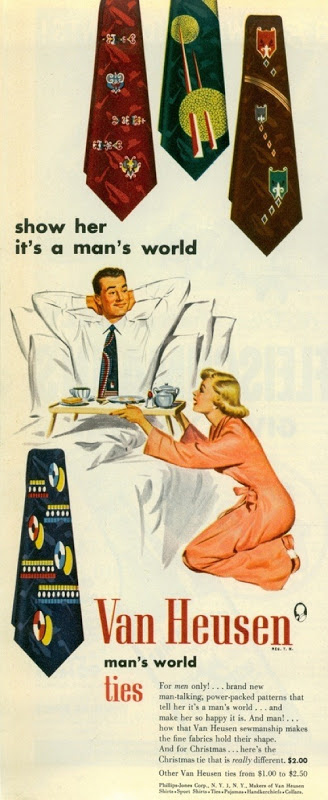
The ad to the left is from the 1950s and shows a woman serving a man. The caption reads “Show her it’s a man’s world” This is saying that men are dominating in the world and women are just servants to the men. The ad on the right shows a male and a female advertising the same shirt. The man is casually wearing the shirt but the woman is sexualising it. The object of the ad was to show that the shirt can be worn by men and women but it looks as though both ads are directed to get men’s attention. The media is using people to meet the sexual craving to sell their products and women don't deserve to be treated as an object.

People who practice religion may believe that stereotypes have many other possible roots and that there is nothing to be done about it. It’s understood that people have different opinions on the subject but because of the beliefs of religion and the stereotypes that have formed because of it, sexism is still a problem in society today. Women (and sometimes men as well) are being taken advantage of in media, in economic terms and just in general and it needs to be stopped.

Why Sexism? No Gender Equality?

Imagine the world, where everybody is equal. There will be no discrimination, no conflict and no assault. We all once dreamed that it will be what the world is going to be, but unfortunately, that is not what the world wants to be. Not everybody is nice as we think, and they will make obstacles to stop our dreams from happening. Discrimination, sexism, things that stop the dream we all long for it to be true. Religion and cultures have their own practises, but that does not mean that there cannot be a female priest, female that take the roles that are stereotypical male roles. At the current rates, the world is changing, with the first lady of the United States, Michelle Obama, and the first female resident in the world, Marma Estela ‘Isabel’ Martinez Cartas de Peron of Argentina.Even though those people have broken walls of gender discrimination, there are still many barriers made from culture beliefs to religion. Every female should have a right to education, to learn even the basics of how to read and write, that girls can play any sport they want, even if it is a boyish sport like contact rugby, and women should have the same wage as men for the same jobs.

People say that ‘education is a right, like the right to have proper food and a roof over your head.’ For many, it is funny that girls do not need to go to school, and part of the reason is that they do not have a choice. They might not have enough money, or their parents do not want them to go to school, and instead helping the farm etc. Many girls in the world are rejected for what they want to do, going to school. According to the book ‘I am Malala’, she was shot in the head for what she wants to do. Yes, the talibans have their reasons, but people in the opposite sex are humans as well. And it is normal for humans to go to school. In other countries, girls can go to school without people shooting their head because they go to school. They face a different obstacle, things like pregnancy, child marriage, poverty and school based violence. In worst case scenarios, those people get discriminated because they are trying to get through those obstacles that others might not realize. They are discriminated because they are different than the other students around them.

According to the UN, there are 7 main advantages for girls having a good education. (some not relevant)
- Education beats poverty. One extra year of schooling increases a person’s earnings by up to 10%. 171 million people could be lifted out of poverty if all students in low-income countries left school with basic reading skills. This explains that education is proven to help people to get out of poverty. - - Education can help people to get out of those harsh rural areas with bad living conditions to the great white way.
- Education promotes gender equality. Women who went to school understand the danger in processing a child, and this helps them to control how many children each family can have. For example, in Mali, a women with at least a secondary education have an average of 3 children, while those with no education have an average of 7 children. This explains that with education there will be a decrease of population, and the world will not be so overpopulated, and that people will not produce a lot of children knowing the dangers of producing a lot of children.
- Education contributes to provide maternal health. Women with higher levels of education are more likely to delay and space out their pregnancies, and to seek health care and support.
- Education helps combat HIV, malaria and other preventable diseases. This facilities access to treatments and fight against stigma and discrimination. This means that education can decrease the world’s death rate, whether it have a positive effect or a negative consequence.
- Education helps global development. ‘An estimated $16 billion in aid is needed annually to reach the EFA goals in poor countries. However, in 2008 poor countries received only $2 billion aid for basic education. The worldwide military expenditure for 2009 was $1.5 trillion.’

Stereotypical girls, do they have to sacrifice of what they want to be in the future just because of their gender? This theory applies for jobs. One of the main streaks of employment discrimination is gender. Why can’t girls work as an engineer? Rejecting a female because of her natural habitat? Rejecting a female just because… because she is a female? The world can create any kind of nonsense they want us to face.
(Unfinished)

Sports. Either its rugby, baseball etc, many debate that girls should not play boy sport. Firstly, how will you define boy sport? A sport that only boys can play? Can’t all girls play boy sport? Why not just make a girl team? Many say that girls are not as physically strong as boys, but girls can play what sport they want to play. Girls are generally stereotypically at home, as the men are stereotypically known as wiser. Sports like football, contact rugby and baseball are generally known as boy sport. Some people have to give up what they love because of what they are born into. Girls are just as good as the boys. Maybe with longer hair, silkier skin, slightly shorter, a little less masculine, they are just the same. Some girls could possibly have equal skills perhaps even better. Having their own rights is like having a cupcake that was yours, and was given not by choice to another person. Girls could be tougher than the boys who think they are the best at sports.
Personally, I play quite a lot of sports, but people judge me because I am smaller, shorter and look like I have no muscle at all. Little did they know that I was trained for a long time, and even if I have already showed them that I can play that sport 10 times better than them, they still believe that I am a total brat that is nothing but showing off. Women have their own skills and qualities, but if they wanted to play boy sports, then let their dreams come true. I have also been there when boys discriminated of what sports I should like and what sport I shouldn’t. I have always liked playing sports like badminton, basketball, touch rugby and many other sport, and yet I am still this small. People do not usually believe that I even play sport, generally commenting on the size that I am in. Only a few people see that I always have tanned skin and spotable muscle on my legs and arms. People have to understand that we girls can play whatever sport we want, and might not have to be the same team as the boys. The teams does not matter as much as enjoying the sport itself.

In the world, there are lots of confusions. Disagree or not, those rules have been set to make the world better. Even if there are many people that follow those rules, there are people out there that disagree of what it is made for the better. What we are living now is only the beginning. There are many other challenges in the future that is waiting for humanity to face. We are only solving the first pieces of a jigsaw puzzle. The world need to stop discriminating people. Be the change you want to see in the world. Follow your dreams. Support gender equality.

Sunday, March 20, 2016

Prejudice and Inequality Prevalent in Society

To Kill A Mockingbird meets The Help

Harper Lee’s award-winning classic “To Kill A Mockingbird” and Kathryn Stockett’s “The Help” are both timeless stories about perspective and loss of innocence set in an era of deep-seated racial and social prejudices. These themes are woven into the two novels and help us to understand the life people led in the past. These two books are both stories of racial inequality, a struggle for social dominance, loss of innocence and viewing the world as a good and untouched place and then having that idea ruined by someone. Both novels also highlight the dangers for people in the more privileged classes in challenging the status quo, and the prejudice surrounding African-Americans.

To Kill A Mockingbird is a novel that follows the adventures of a five-year-old girl named Scout, her brother, Jem, and her neighbor’s nephew in Maycomb County, in the American Deep South. It is set in the 1930s, a time when blacks and whites lived segregated lives and prejudice against colored people was widespread and tolerated by authorities. This novel tells us about Tom Robinson, a kind-hearted, African-American man falsely accused but ultimately convicted of raping a white girl and Atticus, Scout’s father, who represents him in court, to the dismay of many members of white society in the county. Throughout To Kill A Mockingbird, the use of symbolism, imagery and metaphors help us to understand the importance of innocence and how it plays a role in the society in which Lee was living when she wrote the book.

The Help by Kathryn Stockett is a novel also set in the Deep South but in the 1960s. To Kill A Mockingbird has a strong influence on this book and some of the issues raised by Harper Lee have been translated into this novel. This story follows Skeeter Phelan, a young, aspiring, caucasian journalist who was deeply inspired by her black maid Constantine while growing up. Skeeter enjoyed a privileged upbringing in the high society of Jackson, Mississippi, with a lot of friends and a position in the very sought after Jackson Junior League Club, run by her best friend and antagonist of the story, Hilly Holbrook. After watching her friends and mother treat their black maids poorly and learning that her old maid Constantine dies, she feels that it is time to make a change and progress towards racial equality. She gains the friendship and trust of a black maid named Aibileen Clark and Aibileen’s best friend Minny Jackson. Her dream is to write a collection of stories from a dozen maids and their experiences working with white women. Through much persuasion and time spent building the trust of maids and other domestic workers, she gathers two dozen women willing to share their stories.

We can connect these ideologies to real life issues. Today we still face the complex issues of racism, sexism and blatant inequality of gender, race, and religion. As the two books are set in different time periods than they are today, the lasting effect that this era had on our society is still very visible. The divide between black and white people, specifically in the Deep South of United States of America, is what is stopping our world from progressing. African American children and adults are still getting gunned down by police, Muslim children of color are still receiving hate and being blamed for ISIS and women are still earning less money than men for the same job.

In To Kill A Mockingbird, the title gives us a hint of the most significant symbol in the story, mockingbirds. Mockingbirds are the symbol of innocence and childhood. It helps us to remember the feeling of seeing the world through the eyes of a child. As Atticus explains to Jem in chapter ten why it is a sin to kill a mockingbird whilst giving him his first rifle, he says. “I’d rather you shot at tin cans in the backyard, but I know you’ll go after birds. “Shoot all the bluejays you want if you can hit’s, but remember, it’s a sin to kill a mockingbird. […] They don’t do one thing but make music for us to enjoy.” Characters like Tom Robinson, Boo Radley, and Jem Finch can be compared to mockingbirds and are walking metaphors throughout the story. The reason for this is because they are all innocent people who only had intentions to help people throughout the story. Tom Robinson tried to help a woman in need, Boo just wanted to be an accepted member of society and Jem became aware of the amount of evil in the world instead of seeing it as a good place for the first time.

On the night Tom is convicted, Jem becomes finally aware of the evil that has taken place. Even after every single person in the courtroom knows Tom is innocent, yet they sentence him guilty anyways. He says to Atticus. “I don’t know, but they did it. They’ve done it before and they did it tonight and they’ll do it again and when they do it-seems that only children weep. Good night.” This helps us to understand that even though Atticus believes that what the jury has done is wrong, there is not much that he can do to reverse it and change people’s minds.

This can be compared to the characters in The Help. Although it is set in a different time period, the characters in The Help still face the same struggles that ostracized members of Maycomb faced back in the 1930s. For example, Treelore Clark died an avoidable death while trying to earn a living. “One night he working late at the Scanlon-Taylor Mill, lugging two-by-fours, splinters slicing all the way through the glove. He too small for that kind of work, too skinny, but he needed that job.” Because of his color when he was injured he was not treated with the same urgency that a white person would have been shown. Aibileen, Treelore’s mother, explains her son as a quiet, thoughtful twenty-four-year-old man. A person who was about to start his life with his fiance. Aibileen recounts what he was doing and how it happened. “He was tired. It was raining. He slip off the loading dock, fell down on the drive. Tractor trailer didn't see him and crushed his lungs fore he could move. By the time I found out, he was dead.” This shows the working conditions that African Americans had no choice but to work in.

A similarity between To Kill A Mockingbird is how alike the contrasted characters from both books are. For example, in The Help, Skeeter often compares herself to Boo Radley. On page 101 she says. "I've become one of those people who prowl around at night in their cars. God, I am the town's Boo Radley, just like in To Kill a Mockingbird." Common traits that they share are that they are both seen as outcasts, people who do not fit in with the social norm.

Skeeter is an independent, awkward young woman who does not believe in relying on a man and living your life quietly as a housewife. She has aspirations and wants to reach them and feels that people are equal, and for this reason, she is seen as a stain in her bloodline and not a proper lady. For example, when Skeeter is born her older brother Carlton explains. "It's not a baby it's a skeeter!" Thus showing that she is not your average, pretty young woman. Skeeter is almost 6 feet tall and has incurable “kinky” hair and was teased by boys for her looks during middle school. She turned to her maid, Constantine, who told her a life lesson she never forgot. “[You] gotta ask yourself this question. Am I really gonna believe all them bad things them fools say about me today?” This helps Skeeter to remember that she is not what other people say she is. Boo Radley is seen as a murderous and dangerous person by many citizens of Maycomb, adults included while in reality he is actually an awkward but kind-hearted man who wants nothing more than to fit into society. This lesson applies to Boo as well. He is not the rumors about him, but his own person.

The treatment meted out to Boo Radley, Scout’s tormented next door neighbor is another metaphor for the racial prejudice prevalent in society. He is a person who only ever wanted to contribute to society but was ridiculed by his neighbors, ostracized by his community and demonized by children. Everything that was not right in Maycomb was traced back to Boo. For example, when azaleas freeze in a cold snap, it was Boo who did it. “The Maycomb school grounds adjoined the back of the Radley lot; from the Radley chickenyard tall pecan trees shook their fruit into the schoolyard, but the nuts lay untouched by the children: Radley pecans would kill you. A baseball hit into the Radley yard was a lost ball and no questions asked.” Even adults would partake in the rumors, egging on the children and feeding them with lies about how Boo Radley was a bad person who went to prison.

This is very comparable to the treatment that Skeeter is given. As The Help carries on, Hilly Holbrook decides that Skeeter is no longer welcome in the Jackson Junior League and tries her hardest to turn everyone against her. Given that Hilly has a powerful command over one of the major social events and network in Jackson, her influence is enormous. Facing the prospect of losing their social status by upsetting Hilly, even Skeeter’s closest friends turn away from her. Much like Boo Radley, Skeeter quickly becomes ostracized by the other ladies. This goes to show that even though Boo and Skeeter are both white, they are still treated as divergents thus showing that you are still not safe even if you look the same as your enemy.

The vibe that Skeeter and Boo receive for being different really makes us question how our society functions. Just because we are different means that we are not allowed to be accepted? This lesson that was taught years ago has translated into our society today, and people are paying the price for it. Skeeter’s actions highlight the poor treatment given to African American domestic workers and because of the discomfort that causes, Skeeter is ostracized by her friends. It is easier to ignore the inequalities and bad behavior of a certain race when it is your own than to go against society’s prevailing norms. 

Inferring from the text, it is explicit that some of the citizens of Jackson, Mississippi know that the way they treat others is wrong, that it is unfair to put yourself as a race above another and that to act like you are better is completely unjust. However, they do it anyways, and why? Because people feel it is easier to root for the “winning” side, it’s easier to go with the flow and not cause a ripple in the water. Skeeter and Scout prove otherwise, that even though things will be harder than just sticking to the norm, the results are more awarding. 

The Help and To Kill A Mockingbird are stories that make you think about the impact that our behavior has on society. Lee and Stockett have both written stories that put racism into words. These books help us to understand why people feel the need to show dominance and the way that they assert their power, through fear, judgment and strong yet misplaced beliefs. This helps us understand why in today’s society we still have to deal with racist and sexists beliefs, and the reason is because of our past. These two novels show that in a world of hate and prejudice it only takes one person to start a movement, but that the challenges facing anyone who does so remain enormous.
Sunday, December 6, 2015

The Sexist Divide - What society teaches us from birth

“She’s a girl. She can’t play with us.” The voice echoed in the basketball player’s mind. She slumped down in the locker room, cradling her ball to her chest. The day’s events replayed in her head, from school to the bus ride, to basketball practice. She bent her head over, small, painful tears running down her face. Her face burned when she thought about practice. Hugging the ball so tight it hurt, she wondered how she was going to face school tomorrow.

This isn’t fiction. This athlete is only one of many facing sexism in their sports. Even in a school like UWCSEA (east), the sexist divide is still evident even in today’s world. The above example is a minor one, one of many that build up and damage an adolescent’s self-esteem.

A good example of sexism in early ages is a Toys”r”Us store, or most other toy stores. Looking at one from a distance, you can tell the difference in each half of the store. Pink and purple for girls, and every other color for boys. Kids grow up with this thinking, if one thing is used by girls, it can’t be used by boys.

Studies show that 90% of “girls’ toys” are colored pink and purple, while “boys’ toys” come in every color except pink. Some companies are starting to change, such as the Nerf “Rebelle” line, but there is still a long way to go before achieving actual equality.

Another part of this sexism is the kind of toys kids play with. Girls get to play with pink colored baking kits and makeup kits, while there are robot and train building sets for boys. What does this say about women’s role in life?

“Women are still remarkably underrepresented in the U.S. Congress, in science, math, engineering and technology—in any area that could remotely be identified as “the upper echelons of power”—well, it starts in the toy aisle” says Nancy Kaffer, from The Daily Beast. Toys should be neutralized, according to experts, because girls and boys should not have to conform their interests to what society thinks is best.

Fast forward a few years, into middle school. Where kids shift from playing tag to sipping drinks around tables. Similarly to how society picks toys for kids, it sets the standards for your behavior, from your clothes to your activities.

Walking into the H&M Men’s section is strange, but acceptable for a girl. For boys though, it’s a little stranger. Boys just can’t wear dresses. Why is it we have this judgment of what girls and boys should wear?

A possible explanation for this could be that in the past, men were viewed as superior to women. A woman wearing clothes from the Men’s section is unconsciously viewed as stepping up to a man’s level. On the other hand, choosing to wear a dress is stepping down a level for a man.

“Nice shoes, but aren’t they a bit boyish?” Asked a friend of a middle school student at UWCSEA. The shoes were colored red.

“We’d made progress in erasing arbitrary gender divisions….but we stopped” says Kaffer. Once upon a time, society became close to accepting a boy playing with a kitchen set, or a girl playing rugby. Except we didn’t get there.

In class, boys are often asked to help pick up heavy items, and generally expected to be louder and more active. Girls are expected to be more creative, or intelligent, and work harder than boys.

When playing sports, 3 out of every 5 girls feel they are underestimated, according to a study done in UWC. This affects many students, as it puts pressure on their self esteem.

“It does make me feel like I will never be taken seriously,” an anonymous source from UWC says. “People don’t take my love for science seriously, and that is quite discouraging”. It becomes more clear that underestimation or just not being taken seriously can affect a student’s passion for a sport, subject, or hobby.

Why is all of this important?

The reason is, all these minor things lead to as small, but much more impactful events in the future, such as discrimination against colleagues at work, or less opportunities for girls at college. “Subtler forms of sexism that women face can be even more difficult to handle than explicit discrimination,” says Jessica Valenti, writer for The Guardian. This evidence is significant because it demonstrates how hard it is to fix small but hurtful actions.

Men and women are not able to work, play and do everything in between without society choosing the rules. The small things that we see from an early age, like the choice between pink and blue, slowly build up over time, developing into standards for behavior, sport and intelligence. “For young women, there’s added pressure. Because once they get a decent job, they still have to contend with structural workplace discrimination, overtly sexist behavior and a weight of social expectations”, says Natalie Gil, also from The Guardian. Added onto previous evidence, this portrays what young women face in today’s world.

So the next time you go shopping, be aware of the number of small, insignificant forms of sexism that takes place. All of them are why we still believe men can’t wear dresses, or women are not as athletically capable as men. They are the reason girls feel discouraged when they proclaim their passion for science, or the reason boys feel insecure about their hobby of ballet or art. Our society needs to change this, and the small stuff is the starting point.

Or you could pick up a basketball and show them how it’s done.

By Rhea Goyal

Valenti, Jessica. "Everyday Slights Are Just as Harmful to Women as More Blatant Sexism." The Guardian. The Guardian News and Media Limited, 15 Nov. 2015. Web. 1 Dec. 2015.

Kaffer, Nancy. "Sexism Begins in the Toy Aisle." The Daily Beast. Newsweek/Daily Beast, 29 Nov. 2014. Web. 1 Dec. 2015.Gil, Natalie. "It's about to Be a Good Time for Young Working Women." The Guardian. The Guardian News and Media Limited, 23 Nov. 2015. Web. 2 Dec. 2015.