Showing posts with label Society. Show all posts

Sunday, June 12, 2016

Sexism Rooted in Religion and in Society Today


It may be true that society has changed so much over the years and have benefitted everyone. But has it really? People have gotten discriminated against harshly in the past. Most of them women. This may be because of the gender norms and religion beliefs from the past that have over time, modified the way we see different genders. It has affected how different occupations treat women in economic and social ways, and how the media portrays women in society. Religion and gender stereotypes of the past have negatively influenced the sexist behavior (gender inequity) in society today.

Religion may be one of the root causes to gender stereotypes and profiling. In many religions, women have less of a job and men are more powerful. “The religions themselves practice overt discrimination against women within their own institutions. They are run by men for men.” (The roots of sexism in religion) For example, in Christianity, many leadership roles such as the pope, bishops, priests etc are only allowed to be run by men. This shows that already in the past, there weren’t that many women figures. In some other religions, women were just seen as objects that were used for sex or chores. Another example, in the Islamic religion, women are meant to be feminine figures and men masculine. Although this may be sometimes true in the physical sense, that doesn’t mean that all women should be seen in this way. Not everyone has the same idea on how women should be perceived. This is one of the reasons why there are stereotypes that follow this belief.

Stereotypes rooted from religious and social norms of the past have made it harder for men and women to be equal in economic and social terms today. Women have been idealised to do jobs with ‘less brain power’ and more caring, ‘easy’ jobs. Who’s to say that men can’t do them either? Even when men and women have the same job, they still get treated unfairly. “The median earnings of men with full-time, year-round jobs were $50,033 last year, [2013] compared to $39,157 for comparable women.” (The Wall Street Journal, 2013) That’s about a $10,000 difference. Referring back to the earlier point, this may be because men were/are viewed as more powerful therefore sometimes getting paid better.

Sexism has been going on for as long as we can remember. Another example of a time where sexism was a common occurrence was in Salem, Massachusetts in the early 1690s. This was the time of the Salem Witch Trials. Many young women were being accused of harnessing witchcraft and many of them were hanged, even if they were innocent. “ If well-respected men observed the young accusers and reported that their fits were real, then the court would be heeding not just a girl, but an established man.” (Witch-Hunt: Mysteries of the Salem Witch Trials, Marc Aronson) Society chooses to see the good and bad in people. Sometimes they choose to see the good or bad in certain people. Back then, they chose to see the greatness in men and women were just in the shadows. In the quote above, it says

Men and women are being portrayed differently in the media giving society false ideas. The media’s job is to manipulate people’s brains into thinking that they want or need something. For a long time, they have been using people to sell their product or services but in different ways. “I guess the sexism kind of morphed, it didn’t go away or necessarily get better.” (Buzzfeedyellow, 2015) Women usually get exploited to get men’s attention. You may be familiar with the saying “sex sells”. The media certainly believe so and so must the viewers because now there is more of a demand for ads of this genre because companies keep producing them.


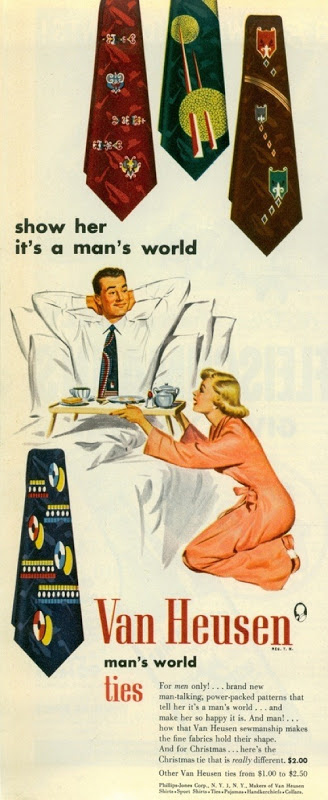
The ad to the left is from the 1950s and shows a woman serving a man. The caption reads “Show her it’s a man’s world” This is saying that men are dominating in the world and women are just servants to the men. The ad on the right shows a male and a female advertising the same shirt. The man is casually wearing the shirt but the woman is sexualising it. The object of the ad was to show that the shirt can be worn by men and women but it looks as though both ads are directed to get men’s attention. The media is using people to meet the sexual craving to sell their products and women don't deserve to be treated as an object.

People who practice religion may believe that stereotypes have many other possible roots and that there is nothing to be done about it. It’s understood that people have different opinions on the subject but because of the beliefs of religion and the stereotypes that have formed because of it, sexism is still a problem in society today. Women (and sometimes men as well) are being taken advantage of in media, in economic terms and just in general and it needs to be stopped.

Our Society and Slavery


In the First World, we think of slavery as dead. Over. Gone. We think of it as an historic aberration, a blemish on the past, but certainly not something that still exists in modern times. Yet over 27 million people are still enslaved today, and that number isn’t decreasing. Slavery is not dead at all, we just don’t notice it, and our failure to acknowledge its existence,it allows it to continue unchecked. To truly abolish slavery we must take down a system that is already in place, and has been in existence for thousands of years. Slavery is deeply ingrained into many sections of society, and to eradicate it we must change society.

The most challenging part of stopping slavery is giving up our reliance on it. Unseen slavery powers many parts of the world economy, and so we all rely upon it, knowingly or unknowingly. The list of major companies that use slave labor is long, and shockingly includes many iconic brands such as Nike, Apple and Disney. The fact that we in the First World allow anyone, especially such high profile, successful companies, to get away with exploiting people is truly atrocious and shameful, and most of us are shocked to learn about it. So how does it come about? What is modern slavery?

Slavery relies on systems of bondage, discrimination and exploitation that have been in place for thousands of years and have continued to grow and evolve throughout history. Modern slavery is also fueled by globalisation. The movement of people, money, and information throughout the world, and the spread of production, supply, and distribution chains has allowed modern slavery to grow, and enabled it to stay out of the grasp of authorities. Of course Nike, Apple and Disney don’t directly enslave people, but their suppliers do, which makes them, the companies and us, their customers, ultimately responsible for the exploitation of slave labor.

Modern slavery exists in many forms, the most common of which is debt bondage. Debt bondage occurs when people are encouraged to borrow money, often on the promise of a better job, or a better life elsewhere. The debt they are subsequently forced to pay back is massively inflated by interest and other charges, so these people end up working for years with no reward, in short as slaves. Sexual slavery, where people, usually women and children, are forced to work in the sex industry is also flourishing in modern times. As is domestic servitude, where the normal and legal practice of live in help is used to cover the exploitation and control of another person, and contract slavery, where people are deceived into slavery by a false employment contract. So you can see that while the traditional chattel slavery, where a person is legally owned by another, may be virtually extinct, slavery itself is alive and well.

How is it that this abhorrent and illegal practice is so widespread today? Put simply, it is because we aren’t doing enough to stop it. Kevin Bales, president of Free The Slaves, says that the fact slavery is still thriving comes down principally to ignorance about the institution and lack of resources directed at eradicating it. This is particularly true in first world countries where we are often not aware that slavery is not exclusively a thirld world problem. Many people in first world countries believe that slavery is nothing to do with them and that they are powerless to prevent it. Nothing could be further from the truth. We all benefit from the slave trade, only the slaves themselves do not.

Slavery may be illegal in every country in the world, but that does not mean it doesn’t exist. Between 14,000 and 17,500 people are trafficked into the United States each year. Most are forced into the sex trade, domestic servitude, or agricultural labor. At any one time, between 52,000 and 87,000 are in bondage. We don’t notice these people because we don’t realise what they are, we simply don’t perceive them as slaves. David Batstone, the author of ‘Not For Sale’ describes how he had, unknowingly, been dining at a restaurant staffed by slaves. “That’s the paradox: slavery is in reality not invisible, Except in rare circumstances, slaves toil in the public eye. The truth is that we do not expect to find it in “respectable” settings.” he writes.

We may prefer to think of slavery as a thing of the past, but in doing so we turn a blind eye to the crime of slave trading and we fail to acknowledge the suffering of the slave. David Batstone also writes that

“Many people bristle to hear the word slavery used to describe the modern practice of exploitation. Deeply ingrained in the collective psyche of Western culture is the notion that slavery ended in the nineteenth century. It is not unusual to read a newspaper account of “slavelike conditions” in a copper mine in, say, Bolivia. The laborers were kidnapped, coerced to work without pay and prohibited from leaving the mine. So why would the writer ferfer to the laborer’s conditions as “slavelike”? Because the writer buys into the cultural myth that “real slavery” was vanquished long ago.”
If we continue to deny the suffering of these millions of people, nothing will change.

Slavery will only be eradicated if we all take responsibility for its existence. All sections of society must acknowledge their reliance on slavery and take active steps to cease this unhealthy dependency. It is no good pleading ignorance and shifting the blame onto others. We must all stand up to be counted and reject slavery in its entirety. We must boycott products and services produced by slave labour, even if this means paying higher prices. We must lobby our governments to enforce anti slavery legislation, to end human trafficking and to help other nations tackle the endemic poverty, corruption and violence which allows slavery to flourish. We must provide better opportunities for those at risk of exploitation and we must work to overturn cultural norms which encourage and condone the exploitation of others. Slavery is a scourge on humanity and it is the responsibility of all humankind to work towards its abolition.

Should Child Soldiers Be Welcomed Into Society?

Out of curiosity, have you ever wondered how the world is so unforgiving? No matter how severe the issues are, ranging from the tiniest and smallest of matters to large and broad, the world will impact you and others drastically. Imagine yourself in a country or an area, where your privacy, your safety, and your dignity is stolen away from you, how would you react? Angrily? Depressed? Frustrated? When this situation is addressed towards child soldiers, they are forced to have no feelings. Have you also, ever been put in a situation where you had to make an extremely onerous and difficult decision for the betterment of you. When such decisions are displayed towards child soldiers, it is either for the sacrifice of themselves or for their families. As we can see, the lives of child soldiers is exceedingly relentless and inflexible, however, the debate about child soldiers is a complex and an intricate topic, where the term “justice” does not apply for both sides. Although many may think that child soldiers might have detrimental influences to the community around, especially children, I take the position that when and if our privacy is stolen from us, our instincts will always be presented and shown before our values, as an act for protection, therefore, child soldiers are victims of war and should be accepted into society, because, they are threatened and forced to join the army, they believe they are fighting and seeking for social justice, and, some volunteer to join the army as a plan for survival.


First and fore-mostly, child soldiers would be considered victims of war because, they are forced and threatened to joined the army. It is estimated that around two hundred thousand children have fought in wars, under the age of sixteen due to this inhumane action caused by armies. Children were often the primary targets because they were less likely to rebel, and, easy to manipulate, therefore, many children were often abducted into the army mainly because they were cheap, resourceful, and could be used for a variety of other purposes. With this, once recruited into the army, children face and come across terror and physical abuse, socialising them into violence. Also, once they are in the army, they undergo varying degrees of indoctrination, often brutal. Moreover, if children rebelled, they are subjected to extreme punishments such as beating, whipping, caning, and sometimes, the threat of execution. During conflicts, commanders supply drugs such as marijuana to children to make them brave and lessen the fear of combat. Many children are compelled and obliged to follow these orders as a reminder for the severe punishments they could receive. “If you didn’t comply with orders, you will be punished badly” stated by one of the members in the Human Rights Watch. Acknowledging this, coercion and fear will always play a major role in the lives of child soldiers throughout their lives. However, let us not forget that some might convey strongly that the whole terminology of responsibility does take place in the life of a child soldier, meaning that they are responsible for committing the crimes.


As mentioned from the above, child soldiers would also be considered victims of war, as, they believe and think they are fighting for social justice. Like adults, they see themselves fighting for a reason or a cause which they might feel good about. They also think it has a deep connection to various religious beliefs and cultural identities. Due to this, child soldiers are unaware of their actions as what they think they are trying to do, is help. As stated previously, when children are recruited into the army, they go through the process of indoctrination, which is the process of teaching someone to accept certain values and beliefs uncritically. As we can now understand, by this method, it will alter their mindset to do wrong and false actions which will lead them to nowhere whilst they think they are doing the right things. Without having any education, it is frankly absurd to call child soldiers perpetrators of war without having any background knowledge of how disheartening their issues and life-stories might be. “A war that includes children, is a war no-one can win”. In your daily life, it is natural for you to feel sorrow for someone, especially a member of your family, however, how is it fair if we don’t treat child soldiers the same way. After all, we are all humans, so we all should treat each other the same and equally.


Correspondingly, child soldiers would be considered victims of war, because, they joined the army as a plan for survival and entering the army camp would be an ideal option for them. When it comes to making decisions for children, it is natural for them to normally get stuck and confused whilst deciding as their minds and bodies are still growing, whereas, for adults, it is essentially quicker. If children are put in such situations when making decisions for survival, they make decisions without any thought of the outcome because, when our safety is taken from us, our instincts play a role before our values as an act for protection. This decision however would be considered and contemplated as an ideal option because, in developing countries, food, water, and shelter is extremely scarce and deficient. Also, parents volunteer their children for the betterment of their lives, and risk their own for saving them. It is extremely plaintive to see how these people struggle and live with their lives everyday despite conflict and war surrounding them. Imogen Prickett, one of the members from the Child Protection Programmed stated “some of the army units provide food and stable life” This proves how strong the influences are at the units, and how such good opportunities has arrived to child soldiers in order to survive. When it comes to survival, it is every man for themselves.


Although these reasons and evidence may be valid and compelling, many may dispute that because of the influences child soldiers had received during conflict, it may be detrimental to their surroundings and environment. As stated previously, the term “justice” does not apply for both sides of the argument, so there will be not be any win or loss, accomplishment or defeat, but completely in the middle of it. The fact about child soldiers and their influences could be detrimental as others might rebel against a certain community starting conflicts. It could also spur up arguments causing a major breakthrough between two parties. Although these arguments might be very convincing, it is very unlikely this might happen so, as, they have not been introduced to the real education. In Ishmael Beah’s story, a long way gone, describes a specific scene where a couple of kids asked him about the war and thought it was cool, nonetheless, he did not react in any way. This proves how education can change someone’s perspective on the real world and shape them to be a better person


In everyday life, we make decisions that we are aware of, and we all know it has impacts either positively or negatively. Nevertheless, when making decisions that could determine your own life, is extremely shocking and appalling. The good thing however, is that we know what we decision we are taking, and possibly, we know the outcome. On the other hand, child soldiers, are firstly uneducated, and make decisions randomly need not knowing what their possible future might be. With very little knowledge learned about the lives of child soldiers, it is unfair and unjustifiable to call child soldiers perpetrators or prosecutors of war. It is important to strike a balance between guilt and honour, and in order to do so, there needs to be sufficient understanding of the topic without instantly claiming or proving a point. Our lives may be completely different from child soldiers but it is crucial to understand how much of a privilege we have. You also must be wondering, why should I really care about this? What is the point? Because after all, we will be impacted too because if nobody takes any action, who will?

Sunday, March 20, 2016

Personal Appearance And Personal Identity


Adolescence is a time at which people from all places and cultures struggle to form their own identity. No longer children, but not yet adults, they must forge their sense of self and come to terms with the image they project to others. For young girls in particular, self identity and image is often closely associated with physical appearance. “Blue Gold” and “ Does My Head Look Big In This?” are both coming of age stories in which young girls from different places and cultures struggle to form their own identities, and in each of the stories physical appearance and clothing play an important part in the girls’ journeys towards self affirmation.

“Blue Gold” is a three part story which confronts the issues surrounding the technology industry through the stories of three girls from very different cultures in living in very different circumstances in different places around the world. Each girl must try to find her sense of self and make a place for herself in society. “Does My Head Look Big In This?” is the story of an Australian-Palestinian-Muslim girl and her journey towards self discovery. She must reconcile her Palestinian Muslim heritage within her place in secular Australian culture. A shared theme between these two books is that physical appearance and dress are central to self identity and image.

In “Blue Gold” Elizabeth Stewart uses Laiping’s uniform to show her loss of self identity and freedom. Laiping is a Chinese factory worker, the factory uniform, identical to thousands of others, demonstrates Laiping’s insignificance in the eyes of the company that controls her. Her uniform strips her of her personal identity and transforms her into “just a factory girl, like a hundred thousand others.” Laiping loses all sense of self and self empowerment. The idea, of clothing having the power to take away identity as well as display it, is also prevalent in ‘Does My Head Look Big In This?’ Once Amal starts to wear the hijab, people perceive her differently; “Too many people look at it as though it (the hijab) has bizarre powers sewn into its microfibers. Powers that transform Muslim girls into UCOs (Unidentified Covered Objects), which turn Muslim girls from an 'us' to a 'them.” When Amal dons the hijab people view her not as herself but as a Muslim, they ignore her character and focus her religion alone. To Amal this is not the way the hijab should be viewed. To her it is a symbol of her religion of which she is justly proud, it is not meant to strip her of identity but help project it. Throughout the story, Amal meets many people who are weary of Islam and who see the hijab as the single most important thing about her. However fortunately Amal also meets people who understand that the hijab is simply a symbol of her religion, an important part of her identity but not her sole defining characteristic.

In “Blue Gold” the story of Sylvie, a Congolese girl who is trapped in a refugee camp in Tanzania, is closely linked to her personal appearance and dress.The main focus of her story is her impending forced marriage to a ruthless warlord named Kayembe. Kayembe wants to marry her because she is pretty, he has no interest in her character or values. He views her as an attractive chatel. On the day of her wedding she is forced to wear a dress chosen by Kayembe.The dress is described as being too long and having “wires in it to shape a woman’s bosom.” Clearly Sylvie is being forced into womanhood too early, she is entirely under Kayembe’s control, her identity and self empowerment are being stripped away and the wedding dress is a powerful symbol of this . Conversely while many people in Amal’s story assume that the hijab is a symbol of oppression and that she was forced into wearing it, when this is definitely not the case. The hijab is an integral part of Amal’s self identity and image. Amal chooses to wear the hijab without any pressure from her parents. She does so because she is proud to be a muslim woman, to her the hijab demonstrates her identity and self empowerment.

In “ Blue Gold” Fiona’s story is one which concerns body image as part of a young girl’s self perception and identity, which can be connected to one of Amal’s friends, Simone. Fiona’s world comes crashing down around her as a topless photo that she foolishly sent to her boyfriend is released onto the internet. She is bombarded by unwanted comments from her peers, as well as people she has never met. She loses confidence in herself and her body. The lack of clothing in the photo is not only a plot point, it is a symbol for her vulnerability. In “Does My Head Look Big In This?”, Amal’s best friend Simone also struggles with body image. Poisonous barbs from her mother and judgmental comments directed at her by other students lead Simone to loathe her own body. She tries desperately to lose weight and to achieve a perfect and unattainable figure. It takes the kindness and love of her friends to convince Simone that she is beautiful no matter what she weighs, just as it takes the love and understanding of her mother, teachers and friends to help Fiona regain her confidence and self identity.

Physical appearance and dress contribute to the way we see ourselves and others. The authors of both books understand this and harness the concept in the development of their characters and storylines.“Does My Head Look Big In This?” takes a very overt position with the clothing being a central theme of the book whilst “Blue Gold” weaves the symbolism of clothing (and even the absence of clothing) into the underlying stories.”Does My Head Look Big In This?” forces the reader to confront the issue of clothing and question whether clothes make a person or whether they are merely another layer of the character's identity. In Blue Gold, however, the theme of physical appearance and dress was largely understated however when focussed upon was both powerful, intended and well considered.

Prejudice and Inequality Prevalent in Society

To Kill A Mockingbird meets The Help

Harper Lee’s award-winning classic “To Kill A Mockingbird” and Kathryn Stockett’s “The Help” are both timeless stories about perspective and loss of innocence set in an era of deep-seated racial and social prejudices. These themes are woven into the two novels and help us to understand the life people led in the past. These two books are both stories of racial inequality, a struggle for social dominance, loss of innocence and viewing the world as a good and untouched place and then having that idea ruined by someone. Both novels also highlight the dangers for people in the more privileged classes in challenging the status quo, and the prejudice surrounding African-Americans.

To Kill A Mockingbird is a novel that follows the adventures of a five-year-old girl named Scout, her brother, Jem, and her neighbor’s nephew in Maycomb County, in the American Deep South. It is set in the 1930s, a time when blacks and whites lived segregated lives and prejudice against colored people was widespread and tolerated by authorities. This novel tells us about Tom Robinson, a kind-hearted, African-American man falsely accused but ultimately convicted of raping a white girl and Atticus, Scout’s father, who represents him in court, to the dismay of many members of white society in the county. Throughout To Kill A Mockingbird, the use of symbolism, imagery and metaphors help us to understand the importance of innocence and how it plays a role in the society in which Lee was living when she wrote the book.

The Help by Kathryn Stockett is a novel also set in the Deep South but in the 1960s. To Kill A Mockingbird has a strong influence on this book and some of the issues raised by Harper Lee have been translated into this novel. This story follows Skeeter Phelan, a young, aspiring, caucasian journalist who was deeply inspired by her black maid Constantine while growing up. Skeeter enjoyed a privileged upbringing in the high society of Jackson, Mississippi, with a lot of friends and a position in the very sought after Jackson Junior League Club, run by her best friend and antagonist of the story, Hilly Holbrook. After watching her friends and mother treat their black maids poorly and learning that her old maid Constantine dies, she feels that it is time to make a change and progress towards racial equality. She gains the friendship and trust of a black maid named Aibileen Clark and Aibileen’s best friend Minny Jackson. Her dream is to write a collection of stories from a dozen maids and their experiences working with white women. Through much persuasion and time spent building the trust of maids and other domestic workers, she gathers two dozen women willing to share their stories.

We can connect these ideologies to real life issues. Today we still face the complex issues of racism, sexism and blatant inequality of gender, race, and religion. As the two books are set in different time periods than they are today, the lasting effect that this era had on our society is still very visible. The divide between black and white people, specifically in the Deep South of United States of America, is what is stopping our world from progressing. African American children and adults are still getting gunned down by police, Muslim children of color are still receiving hate and being blamed for ISIS and women are still earning less money than men for the same job.

In To Kill A Mockingbird, the title gives us a hint of the most significant symbol in the story, mockingbirds. Mockingbirds are the symbol of innocence and childhood. It helps us to remember the feeling of seeing the world through the eyes of a child. As Atticus explains to Jem in chapter ten why it is a sin to kill a mockingbird whilst giving him his first rifle, he says. “I’d rather you shot at tin cans in the backyard, but I know you’ll go after birds. “Shoot all the bluejays you want if you can hit’s, but remember, it’s a sin to kill a mockingbird. […] They don’t do one thing but make music for us to enjoy.” Characters like Tom Robinson, Boo Radley, and Jem Finch can be compared to mockingbirds and are walking metaphors throughout the story. The reason for this is because they are all innocent people who only had intentions to help people throughout the story. Tom Robinson tried to help a woman in need, Boo just wanted to be an accepted member of society and Jem became aware of the amount of evil in the world instead of seeing it as a good place for the first time.

On the night Tom is convicted, Jem becomes finally aware of the evil that has taken place. Even after every single person in the courtroom knows Tom is innocent, yet they sentence him guilty anyways. He says to Atticus. “I don’t know, but they did it. They’ve done it before and they did it tonight and they’ll do it again and when they do it-seems that only children weep. Good night.” This helps us to understand that even though Atticus believes that what the jury has done is wrong, there is not much that he can do to reverse it and change people’s minds.

This can be compared to the characters in The Help. Although it is set in a different time period, the characters in The Help still face the same struggles that ostracized members of Maycomb faced back in the 1930s. For example, Treelore Clark died an avoidable death while trying to earn a living. “One night he working late at the Scanlon-Taylor Mill, lugging two-by-fours, splinters slicing all the way through the glove. He too small for that kind of work, too skinny, but he needed that job.” Because of his color when he was injured he was not treated with the same urgency that a white person would have been shown. Aibileen, Treelore’s mother, explains her son as a quiet, thoughtful twenty-four-year-old man. A person who was about to start his life with his fiance. Aibileen recounts what he was doing and how it happened. “He was tired. It was raining. He slip off the loading dock, fell down on the drive. Tractor trailer didn't see him and crushed his lungs fore he could move. By the time I found out, he was dead.” This shows the working conditions that African Americans had no choice but to work in.

A similarity between To Kill A Mockingbird is how alike the contrasted characters from both books are. For example, in The Help, Skeeter often compares herself to Boo Radley. On page 101 she says. "I've become one of those people who prowl around at night in their cars. God, I am the town's Boo Radley, just like in To Kill a Mockingbird." Common traits that they share are that they are both seen as outcasts, people who do not fit in with the social norm.

Skeeter is an independent, awkward young woman who does not believe in relying on a man and living your life quietly as a housewife. She has aspirations and wants to reach them and feels that people are equal, and for this reason, she is seen as a stain in her bloodline and not a proper lady. For example, when Skeeter is born her older brother Carlton explains. "It's not a baby it's a skeeter!" Thus showing that she is not your average, pretty young woman. Skeeter is almost 6 feet tall and has incurable “kinky” hair and was teased by boys for her looks during middle school. She turned to her maid, Constantine, who told her a life lesson she never forgot. “[You] gotta ask yourself this question. Am I really gonna believe all them bad things them fools say about me today?” This helps Skeeter to remember that she is not what other people say she is. Boo Radley is seen as a murderous and dangerous person by many citizens of Maycomb, adults included while in reality he is actually an awkward but kind-hearted man who wants nothing more than to fit into society. This lesson applies to Boo as well. He is not the rumors about him, but his own person.

The treatment meted out to Boo Radley, Scout’s tormented next door neighbor is another metaphor for the racial prejudice prevalent in society. He is a person who only ever wanted to contribute to society but was ridiculed by his neighbors, ostracized by his community and demonized by children. Everything that was not right in Maycomb was traced back to Boo. For example, when azaleas freeze in a cold snap, it was Boo who did it. “The Maycomb school grounds adjoined the back of the Radley lot; from the Radley chickenyard tall pecan trees shook their fruit into the schoolyard, but the nuts lay untouched by the children: Radley pecans would kill you. A baseball hit into the Radley yard was a lost ball and no questions asked.” Even adults would partake in the rumors, egging on the children and feeding them with lies about how Boo Radley was a bad person who went to prison.

This is very comparable to the treatment that Skeeter is given. As The Help carries on, Hilly Holbrook decides that Skeeter is no longer welcome in the Jackson Junior League and tries her hardest to turn everyone against her. Given that Hilly has a powerful command over one of the major social events and network in Jackson, her influence is enormous. Facing the prospect of losing their social status by upsetting Hilly, even Skeeter’s closest friends turn away from her. Much like Boo Radley, Skeeter quickly becomes ostracized by the other ladies. This goes to show that even though Boo and Skeeter are both white, they are still treated as divergents thus showing that you are still not safe even if you look the same as your enemy.

The vibe that Skeeter and Boo receive for being different really makes us question how our society functions. Just because we are different means that we are not allowed to be accepted? This lesson that was taught years ago has translated into our society today, and people are paying the price for it. Skeeter’s actions highlight the poor treatment given to African American domestic workers and because of the discomfort that causes, Skeeter is ostracized by her friends. It is easier to ignore the inequalities and bad behavior of a certain race when it is your own than to go against society’s prevailing norms. 

Inferring from the text, it is explicit that some of the citizens of Jackson, Mississippi know that the way they treat others is wrong, that it is unfair to put yourself as a race above another and that to act like you are better is completely unjust. However, they do it anyways, and why? Because people feel it is easier to root for the “winning” side, it’s easier to go with the flow and not cause a ripple in the water. Skeeter and Scout prove otherwise, that even though things will be harder than just sticking to the norm, the results are more awarding. 

The Help and To Kill A Mockingbird are stories that make you think about the impact that our behavior has on society. Lee and Stockett have both written stories that put racism into words. These books help us to understand why people feel the need to show dominance and the way that they assert their power, through fear, judgment and strong yet misplaced beliefs. This helps us understand why in today’s society we still have to deal with racist and sexists beliefs, and the reason is because of our past. These two novels show that in a world of hate and prejudice it only takes one person to start a movement, but that the challenges facing anyone who does so remain enormous.
Sunday, December 6, 2015

THE EFFECTS OF BODY SHAMING AND BODY OBJECTIFICATION

A girl with short hair walks down the corridor. As she turns into her class she hears an insult being called out behind her. “Gay,” a group of girls shout.

Today, body shaming has become a regular occurrence. Body shaming and sexualising people regardless of gender is a very dangerous thing. 5/7 of students of both genders in 8SMd have felt the need at some point in their lives to change themselves due to others opinions about their bodies.

There are many generalisations about body shaming. Often, people feel as though body shaming only happens to girls which is a stereotype in itself. It can happen to anyone, owing to the stereotype of the ‘perfect look’ as propagated by social media.

After carrying out a survey I learnt that 10 out of 14 people in 8SMd, are insecure about so many different parts of their bodies and just how they look. An anonymous source in this class has said, “ There have been multiple occasions where I have wanted to change what I have looked like to try and fit in with different people in different schools.” This evidence is significant because it shows that objectification does not just happen to adults and it does not just happen on social media. This represents that it can happen in school, at home and that people of all ages are affected by body shaming.

Girls and boys go to unreasonable extents to look like models or celebrities. “In the United States alone 1.5% of women / 4.7 million women and 0.5% of men / 1.5 million men are threatened by Bulimia, an eating disorder which is usually diagnosed in young adults.” says the Mirror-Mirror.org website. It has been diagnosed in people as young as 6 years old and can be diagnosed in adults too. The idea of a perfect body has unfortunately become a mindset deeply entrenched in society. This gets reflected in ads, social media, TV shows and movies. And sadly, this is the thinking that has seeped into children as young as 6 years old who in the process can become Bulimic.

Dress codes can be a massive problematic contribution to objectification. In August, 2015 Stephanie Hughes of Versailles, Kentucky was sent home from school for exposing too much of her collarbone. “Woodford County High School and the principal have been enforcing a dress code where girls can not show even their collar bones because it may distract their male classmates,” wrote Stacie Dunn, Stephanie’s Mum, on Facebook.Because school is a very influential place, dress codes have started to make girls and boys more conscious of what they are wearing and what they look like. This has made it much more visible that objectification can come from anywhere, even your teachers and fellow classmates.

Rhea Goyal, an 8th grade student has shared an experience saying that, “Because I am quite skinny people usually view me as somebody who cannot play sports because I do not look like I have a lot of muscle mass.” Unfortunately this is a stereotype that is placed on a lot of people due to their body image. Because of magazines and TV, we view athletes as big built and strong, yet because the stereotypes have so much power over us we never tend to overlook that materialistic mindset.

Media has played a pivotal role in creating unreal images of ideal beauty. For a long time now the ideal body for a women has been an hourglass figure. In order to be beautiful you have to have translucent skin and be extremely skinny to the point where it usually is impossible to have a figure like that. For a man it is all about a macho image and a six-pack body. As media evolved and social media became popular, people started to try and get justification about their looks through likes and comments on their pictures. Throughout this evolution we just started getting more and more materialistic about the subject of beauty.

A girl with short hair walks past a slightly overweight girl in the corridor and calls out, “Lose some weight!”

Words are powerful. Stereotypes are powerful. The sooner we stop body and objectification, the sooner we will start to realise that people are more than just bodies. As BeautyRedefined.org rightfully says, “See more. Be more.”

By: Rhea Shrivastava


Don't Listen to the Stereo

From a young age, we are introduced to a world full of stereotypes. Specifically, gender. The media, our parents, our religion and our society are just some of the aspects that influence our beliefs and in a way, have overtime created gender stereotypes. They can sometimes teach us unideal ways of living. Stereotypes categorise humans into groups that tell us what we are meant act or be like, which in result can make many feel untrue to themselves or like outcasts.

Her life has been set out for her. Finish school, get married, have kids and support the breadwinner of the family.

Noshin is terrified as she overhears her mother on the phone with her grandmother, sobbing one night, saying that her life has been ruined by the men in their family. Her grandmother’s whole life consisted of assisting men and she could hardly be her own person. She didn’t want to live like that anymore. Noshin cries to herself thinking about how unfair her grandmothers life was. “In my country, Bangladesh, women are treated more as maids” said Noshin Saiyaara, 14. “The life of a girl; clean the house, cook and take care of the kids.” This makes it clear that to this day, there are still unequal and stereotypical behaviour in society. This could be because of her religion and that they believe it's right. But is it? Should this be socially acceptable in a society where more and more cultures have grown to be more open about the decisions that women make to become more of equals and not maids?

Noshin told our journalist that she wants change. Her siblings and herself are determined to change the traditions of her family to benefit their lives for the better. “I want to change the routines of my family. I’m not going to sit around and do nothing, I want to work and contribute to my family.” Her experience has empowered her to change their ways, to be who she aspires to be in the future.

From a variety of people that took part in a survey on their thoughts about where stereotypes originated, the most commonly agreed opinion, with more than 50% of the surveyed people, is that stereotypes have been an ongoing tradition for a very long time. For instance, during medieval times there were little to no women as knights and it was the men's job to be chivalrous towards the women. Women were thought to be more delicate so their jobs were often to do housework and cook and maintain the family.

In modern day, we have come to a point where stereotypes have been advertised so much, that they have started to infect more and more of the human species into thinking that they might be true. Isabella Duncan, a student from an 8th grade english class thinks that “Overtime, stereotypes have been reinforced by people with fixed mindsets.” In many ways this is true. Through the people in the media and our society, the message that women and men are different and not equals is very clear statement. You may not realise it, but everyday the commercials you see can have traces of gender stereotypically and it’s hard to realise it because they’re just so common.

Many ideas are reinforced through television to a specific audience. To do this, commercials have to make it relatable to the audience hence, showing things a girl and/or boy would do. In the case study “GENDER STEREOTYPES IN MASS MEDIA” by Malgorzata Wolska, she states “More and more commercials are directed to children. They indicate ‘the proper place’ in the society for girls and boys. Girls are shown as babysitters nursing dolls or cleaning house with a pink cleaning kit, whereas boys do sports or play computer games.” It mentions that most commercials main target audience is children, so the concept of gender stereotypically is already being engraved into their heads. In the future, when they understand how it impacts their identity, they will have a ‘template’ to follow.

Everyone can be affected because of gender stereotypes in many ways. Having to be a certain way and being surrounded by people who support gender stereotypes, can sometimes result in peer pressure and bullying. Life as a middle schooler can be hard, considering that there are lots of pressures with fitting in with others. A middle school student who wished to remain anonymous, tells their story “I am a dancer and a singer and that's what I want to do when I'm older. Ever since I was young, I've been bullied for doing what I like to do. I started hanging out with girls because some of them had the same interests in dance as me or they just understood. I think boys are more disturbed with the stereotype issue and they find it harder to welcome misfits, than girls do.” What is revealed here is that sometimes, people can get peer pressured if they don’t follow a stereotype because it's unfamiliar to others, so the action and person is slightly alienated.

What's strange, is that it's harder for a boy to enjoy something that usually a girl would like, than the other way around, because they usually get picked on by other boys who are more manly. Rhea Goyal’s theory for this is that “In the past, boys have generally been viewed as stronger, smarter etc. while girls were viewed as inferior to boys, so now society says it’s okay for a girl to move up to a boy’s standard, but not okay for boys to move down to a girl’s standard.” It suggests that by being a boy and doing things a girl would do, it would make you less of a man, and that you are admitting to being weak.

Lately there has been less discrimination towards people that happen to go against the grain of a stereotype, but it still happens. If you are someone that is in this situation, know that you are not alone and that there are always going to be people to help and are going through something similar. Its great to be yourself, to be unique. Don’t let stereotypes and hateful comments from others hold back what you desire to be or do. “There shouldn't be any barriers or force, because people's choices are their own,” said Noshin Saiyaara.

Let's imagine that all these concepts have been compiled and put into a stereo. Some of the music could be great, and you like to listen to it, but sometimes there is going to be bad music. People might have different tastes to you, but you don’t need to change your taste to please others.

The Impacts of Stereotypes on Children and Society


A girl walks down the hallway with a basketball under her arm and a smile on her face. Suddenly, a group of boys run past knocking the ball away. “Girls can’t play sports.” They laugh as the ball bounces down the hall and the happiness drains out of her. She, along with many others is a victim of stereotypes. Stereotypes are everywhere, and affect the way people view the world around them. From a young age it is imprinted on children that because you are one way, you must do a certain thing or because you believe something, you are the same as everyone else who believes something similar. The people most often caught in the crosshairs of stereotypes, are children. Stereotypes form the way children think about themselves; being so young they are are very impressionable, so if someone tells them something, it sticks.

One parent of a child at UWCSEA East has had an experience with one of the many common stereotypes. “I wanted to buy a construction house building kit for my daughter, but they only ones I could find were in the boys section and I worried that I was buying something not appropriate for girls.” She says. This illustrates a common misconception. In every store most baby clothes are coloured in the way associated with that specific gender. There are stereotypical toys for each gender as well. In the “girls toys section” there are dolls, cooking sets and beauty kits as if preparing them for a life staying home, cooking and taking care of children. In the “boys toys section” there are soldiers, cars and fake guns as if telling them to be violent is the only way to be “manly”. These stereotypes affect children from a very young age and influence gender roles later in life. The children can think it isn’t right to like something from the other gender, and if they do like it then they can feel out of place amongst their friends. This may force them to create a version of themselves that isn’t true to who they actually are.

Noshin Saiyaara is a grade 8 student at UWCSEA East whose life is full of stereotypes. “Most of the stereotypes I face are from my own family, saying that because I am a girl, my life should basically be about school, marriage and becoming a housewife.” She says. This reveals that gender roles are also deeply buried in society’s views. Children can even experience them from their own family. In traditional families it is believed that the role of a woman is to take care of her husband and children, while the man goes out and earns money for the family. In some families this model may work, however girls are capable more than just housework. It is stereotyped that women are somehow incapable of providing their own source of income and need to be taken care of by the man. This stereotype affects young girls growing up to think that they don’t have to try because they’ll get a husband who can take care of them. This thinking can lead to children not living up to their capabilities and not trying their very best.

“Some people assume because I am a Muslim, I am a terrorist.” Noshin continues. Sadly, this is a reality for many people. The growing terrorism in the middle east is causing effects on Muslims all around the world. Many people view them as a threat because of the stereotypes created by a few extremists. In the airports, despite the selections of passengers for further screening being “completely random”, the ones chosen are usually Muslims or Arab. This is due to racial profiling and stereotypes. Everyone is entitled to their religion, and that religion doesn’t determine whether a person has good or bad intentions. It doesn’t just apply for muslims, every religion has a specific look that society feels all members should have. “People think that just because my nose is slightly more arched than most, it must mean I am Jewish.” Said Lia Shoshani, another 8th grade student. Despite the fact that she actually is Jewish, the way she looks should not be what gives it away. Religions cross international borders, and are followed by people all over the world. So to say that all members should look a certain way is discriminating against the majority. This stereotype can lead to children feeling like the world doesn’t accept their religion or that they don’t belong in their religion. That can cause conflicting ideals in a young person who is still trying to find their place in the world.

“People tell me that Indians are smart, so they ask: why aren't you?” Said one student at UWCSEA East when asked if she ever felt subjected to stereotypes. Many have thought that all Asians are smart, and all Asians want to become doctors or lawyers. However many Asians are actually better at other things. Maybe they’re good at sports, maybe their good at art, it depends on the individual. Your race in no way determines your strengths and weaknesses. It is related to your heritage, and although that may influence your interests, every person is an individual and is entitled to their own opinions. These stereotypes can make a child feel as if they have a responsibility to fulfill them. Instead of pursuing their passion, children may change their mind to make the stereotypes true. Just like religion, one stereotype for a racial group is not capable of accurately defining all it’s members.

“I sometimes judge sporty people and think they’re are not exactly good at academics.” The student continues. It is often assumed that someone can only be good at one thing. If you’re good at academics you’re a nerd and not good at sport, if you’re good at sport you’re a jock and dumb. In actual fact, someone’s skills are not only focused on one thing, and hobbies cannot define someone’s personality. Human brains are remarkable, and capable of specialising in more than one area. These generally untrue stereotypes are common in movies and televison, rule the school hallways and can negatively influence the way students view each other from a young age.

Although stereotypes are a huge problem, there are ways in which we can prevent ourselves from using them to judge others. Despite the fact that some may actually be true or rooted in some form of truth, don’t let your first impression of someone get in the way of actually getting to know someone; they may be totally different to how they initially appear. Second, don’t resort to a single story and assume it applies to everyone, it most likely won’t. Finally, be aware of stereotypes the next time you use them to judge someone. Stereotyping is often subconscious and we don’t even realise we’ve done it until the moment has passed.

Stereotypes have surround every topic, and have always been around. However the impacts they are having on today’s society are worsening. “I always feel like a have a sort of responsibility towards the stereotype.” Says Francesca Marshall, another student at UWCSEA East. “I think in a lot of cases people use stereotypes to form opinions on others. They just assume because you’re Asian you’re smart, or because you’re Muslim you’re dangerous. I don’t think people should assume that just because of your race or religion, you’re something you’re not. Everyone is unique and different, stereotypes don't define who you are.”

by Isabella Duncan